Porsche 911 Turbo
The 911 Turbo has always been the usable supercar — devastatingly fast, four-wheel drive, and genuinely drivable in weather that stops other things. We usually hold one or two.
The generations we see
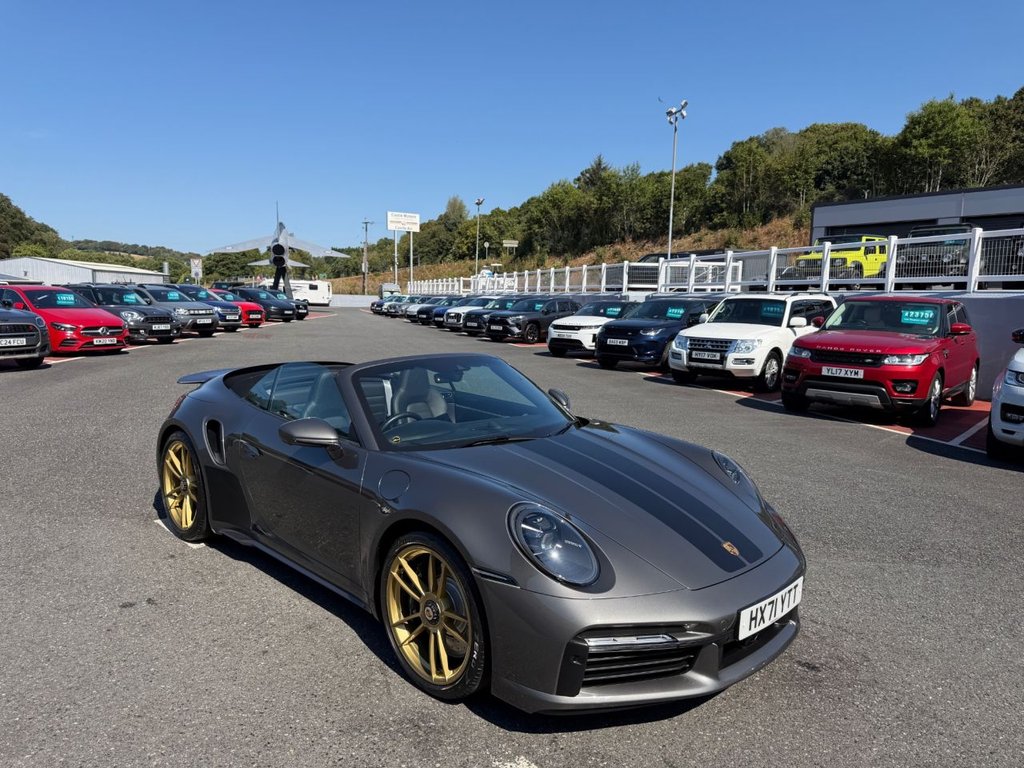
992 (2019 on)
The current shape. Wider, more sophisticated, and quicker than anything wearing the badge before it. Eight-speed PDK only, four-wheel drive, and a level of everyday usability that makes the performance faintly absurd.
Convertibles hold their own in this market — the roof mechanism is superb and the car loses very little to the coupé dynamically.
991.2 (2015–2019)
The last of the 991s and, for many, the sweet spot. Turbocharged flat-six, PDK, four-wheel drive, and now at a price point well below the 992. Gen 2 cars brought a power increase and revised aerodynamics over the earlier 991.1.
A well-specified 991.2 Turbo is one of the more compelling propositions in modern Porsche.
What to look for
- Specification. On a Turbo, options swing value substantially. Ceramic brakes, sports exhaust, rear-axle steering, Burmester and the right wheels all matter at resale.
- History. Main dealer or recognised specialist, unbroken. Gaps cost money.
- Ceramic brake condition, if fitted. Replacement is genuinely expensive — factor it into the price rather than discovering it later.
- Front-end paint. These cars cover motorway miles at speed. Some protection or correction is normal; poorly matched respray is not.
Turbo or Turbo S?
The S brings more power and usually more standard equipment. Both are far beyond what any road allows. The S commands a premium at resale but the gap narrows with age — a well-specified Turbo often represents better value than a poorly specified S.
In stock
Ask us
We are happy to go through a specific car’s specification and history in detail before you travel. Call 01503 240777.